Nigerian Nurses and Midwives to Begin 7-Day Nationwide Warning Strike Over Unfulfilled Demands
 Emmanuel Femi Adedayo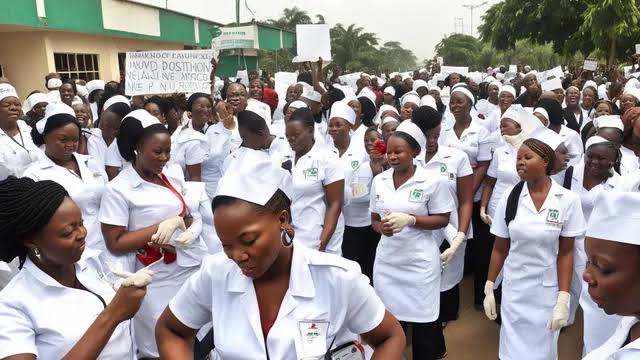
Nurses in federal and state healthcare facilities plan to begin a seven-day warning strike on July 30 over poor remuneration, staff shortages, unpaid allowances, and unsafe working conditions, among other grouses that have lingered for years.
The National Association of Nigeria Nurses and Midwives (NANNM) Federal Health Institutions Sector (FHI) said the strike will affect 74 federal hospitals, other state hospitals and primary healthcare centres.
The strike will also ground services in medical centres, teaching hospitals, and specialist institutions.
NANNM on July 14 issued a 15-day ultimatum to the Federal Government demanding immediate intervention to prevent a total healthcare shutdown, but complain that Abuja has yet to initiate negotiations.
NANNM-FHI National Chairman Morakinyo Rilwan said the long-standing demands include upward review of shift allowance, uniform allowance adjustment, a separate salary structure for nurses, increase in core duty allowance, mass employment of nurses, and creation of a nursing department in the Federal Ministry of Health, among others.
“The strike in question is inevitable as the Federal Government or the Federal Ministry of Health remains adamant,” Rilwan told The PUNCH.
“Right now, nurses are lumped together with other health workers on the same salary scale. There’s no special consideration for the unique work nurses do.
“We want a dedicated salary structure that reflects our profession and contribution. We are not just like every other health worker. We deserve our salary scale.
“Nurses are the only professionals who work round-the-clock shifts. Night shifts are even more demanding and dangerous now due to security concerns.
“We are supposed to receive 30 per cent of our basic salary as shift allowance, as stated in a 2009 circular, but they’re only getting 6.8 per cent, the same as a gate man running shifts.
“It’s unfair. We work the longest hours with patients, and yet they give us crumbs.
“Nurses get N20,000 per year for uniforms, a figure that has not changed in over 20 years, even though nurses wear white uniforms that get stained easily and need constant replacement.
“We wear full uniforms, and we sometimes need several per week. N20,000 can’t buy enough for a year anymore.
“Meanwhile, lab coat allowances for doctors and others were recently reviewed, but nurses were left out, even though uniform allowance is a long-standing rule for nurses and fire service officers.”
Rilwan said nurses want core duty allowance raised from 1.7 per cent to 4 per cent, and noted that despite nurses making up a large chunk of the healthcare workforce, there is no dedicated department for nursing in the Ministry of Health.
“Currently, a Director [of Nursing] reports to another Director from a different department, which undermines the profession. We want a proper Department of Nursing, led by a full-fledged Director, not sidelined under someone else.
“Since 2016, a scheme of service (defining ranks, roles, and duties of nurses) was approved and circulated, but it’s still not being implemented. We’re not asking for a new document. Just implement the one already approved.
“Nurses are still working in hospitals with no gloves, syringes, or gauze. They’re forced to improvise, which puts their lives and their health at risk. We save lives even with nothing. Imagine how much more we can do if we’re properly equipped.
“The government keeps saying there’s a nursing shortage, but Nigeria produces over 10,000 nurses annually, but many are underemployed, working in private hospitals for peanuts or on temporary locum contracts in government facilities.
“We have enough nurses. They just don’t employ or pay them well, that’s why they leave.”
He added that the association wants the reconstitution of the Nursing and Midwifery Council Board dissolved for over four years, and insisted that the strike will affect all levels of public healthcare facilities across Nigeria.
“This includes 74 federal hospitals – teaching hospitals, federal medical centres, specialist hospitals like orthopaedic, neuro-psychiatric, and eye centres, as well as all general hospitals and primary healthcare centres in the 36 states and the Federal Capital Territory, and 774 local government areas.”
NANNM-FHI National Public Relations Officer Omomo Tibiebi alerted that “There will not be emergency services, the strike is total, and there will be no skeletal services.
“The 15-day ultimatum ends by Tuesday, July 29, 2025, by midnight, and the warning strike commences on Wednesday, July 30, 2025, at 12:01am,” he stressed.
About the Author


 Ademola Busayo

 admin
admin 
 Ayo Marvel