Senate Yields to Pressure, Approves Electronic Transmission of Election Results
 Ademola Busayo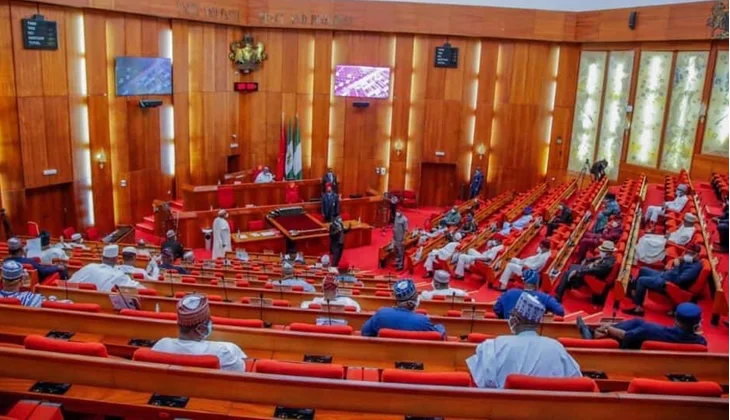
The Senate on Tuesday bowed to mounting political and public pressure by amending provisions on the electronic transmission of election results in the Electoral Act Amendment Bill, although it removed mandatory real-time transmission from the revised clause.
The decision followed a tense and rowdy plenary session that centred on Clause 60 of the bill, which has remained the most controversial aspect of the ongoing amendment process.
Last Thursday, the Senate passed a retained section of the 2022 Electoral Act which provides that, “The Presiding officer shall, after counting the votes at the polling unit, enter the votes scored by each candidate in a form to be prescribed by the Commission as the case may be.
“The form shall be signed and stamped by the presiding officer and counter signed by the candidates or their polling agents where available at the polling unit.
“The presiding officer shall give to the polling agents and the police officer where available a copy each of the completed forms after it has been duly signed as provided under sub section 2.
“The presiding officer shall count and announce the result at the polling unit.”
However, the omission of explicit real-time electronic transmission provisions triggered widespread criticism from opposition figures, civil society groups and pro-democracy movements.
At Tuesday’s plenary, during the adoption of Votes and Proceedings, Tahir Monguno, moved a motion seeking to rescind Clause 60, which had earlier been passed.
Explaining his position, Monguno said, “Upon careful examination of the Bill, fresh issues have emerged in respect of Clause 60(3), which requires further legislative consideration in order to ensure the conduct of smooth, transparent, and credible elections in Nigeria.”
Relying on the Senate Standing Orders, he added, “Relying on the provisions of Orders I(b) and 52(6) of the Senate Standing Orders, 2023 (as amended), accordingly resolves to:
“Rescind its earlier decision on Clause 60(3) of the Electoral Act (Repeal and Enactment) Bill as previously passed; and
‘Recommit Clause 60(3) to the Committee of the Whole for further reconsideration and passage.’”
The motion was seconded by the Minority Leader, Senator Abba Moro.
As confusion trailed the earlier wording, Senate President Godswill Akpabio intervened to clarify the substance of the amendment.
“Let me guide the senators. What I understood, what he proposed in the last sitting was the use of the word transfer, not transmit,” Akpabio said.
“He came to me and mentioned the fact that he would like to propose a motion to ensure that he changes that word.”
Akpabio then formally restated the amendment before putting it to a vote, saying, “His earlier motion which passed in our last sitting, he has sought to rescind that, that is in respect of Section 60(3), and this is what he is proposing.
“He is proposing that the presiding officer shall electronically transmit the results from each polling unit to the IReV portal and such transmission shall be done after the prescribed Form EC8A has been signed and stamped by the presiding officer and or countersigned by the candidates or polling agents where available at the polling units, because sometimes you don’t see any polling agent.
“Provided that if the electronic transmission of the results fails as a result of communication failure — in other words, maybe network or otherwise — and it becomes impossible to transmit the results electronically in Form EC8A signed and stamped by the presiding officer and or countersigned by the candidates or polling agents where available at the polling units, the Form EC8A shall in such a case be the primary source of collation and declaration of results.”
The session turned rowdy when Senator Enyinnaya Abaribe invoked Order 72 and called for a division.
In parliamentary terms, a division requires senators to physically indicate their positions by moving to either side of the chamber.
After heated exchanges, Abaribe withdrew his motion after the Senate President, agreed that the Senate be divided.
“If anybody has a counter motion, we will move it later,” Akpabio said before calling the vote.
“Those in support of the motion as enunciated by Senator Monguno and seconded by Senator Moro, say aye… The ayes have it.”
Following the rescission of Section 60, the Senate also increased the number of members of its conference committee on the Electoral Act Amendment from nine to 12.
Akpabio explained that the decision became necessary because the House of Representatives’ conference committee had 12 members.
The newly added members are Senators Isa Jibrin, Ipalibo Banigo and Peter Nwaebonyi.
The committee, chaired by Senator Simon Lalong, is expected to harmonise the Senate and House versions of the bill and conclude its work within the month to enable transmission of the final document to the President for assent.
Other members include Senators Adamu Aliero, Adeniyi Adegbonmire, Orji Uzor Kalu, Abba Moro, Asuquo Ekpenyong, Aminu Abbas and Tokunbo Abiru.
The Senate’s earlier rejection of mandatory real-time electronic transmission sparked protests and condemnation nationwide.
Oby Ezekwesili, a former Minister of Education; members of the Nigerian Society of Engineers; PDP chieftain Chief Bode George; Yiaga Africa; HURIWA; and the Rule of Law and Accountability Advocacy Centre accused the Senate of weakening electoral transparency.
Similarly, on Monday, Peter Obi, a former Labour Party presidential candidate, , joined protesters under the banner “Occupy the National Assembly”, chanting slogans such as “Our votes must count” and “No to electoral robbery.”
Also, before plenary on Tuesday, Rotimi Amaechi, former Minister of Transportation and ex-Rivers State Governor, also joined demonstrators in Abuja, demanding a reversal of the Senate’s stance.
Security was tightened around the National Assembly, with police barricading major access roads ahead of the emergency plenary session.
Despite the amendment, critics insist that removing mandatory real-time transmission still leaves room for manipulation, setting the stage for further public scrutiny as the bill moves toward harmonisation and presidential assent.
About the Author


 Ayo Marvel



 Emmanuel Femi Adedayo