“In My Tenure, Losers Will Congratulate Winners” — New INEC Chairman, Prof. Ojo Amupitan Declares
 Ademola Busayo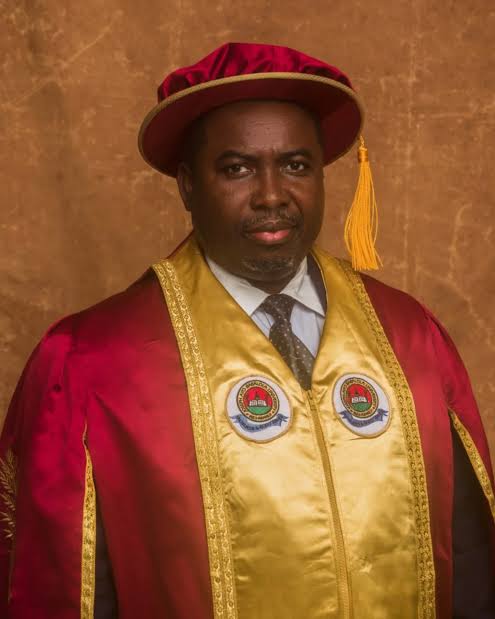
National Chairman of the Independent National Electoral Commission, INEC, Prof. Joash Amupitan, SAN, yesterday, began his tenure on a promising note, assuring that under his watch, elections will be so credible that losers will congratulate winners.
However, Amupitan said he will accomplish this with the support of relevant agencies like the National Identity Management Commission, NIMC, Nigerian Communications Commission, NCC, and others.
He spoke in the Senate before and after the Senate confirmed his appointment by President Bola Tinubu as INEC chairman.
“Our ultimate goal is to make elections so credible that even the loser will be able to congratulate the winner in good faith just as a judge delivers judgment and both sides accept it as fair and just,” he told the lawmakers while answering a question.
Amupitan’s confirmation was sequel to the screening exercise at the Senate, where the senators grilled the nominee of President Tinubu for three hours, asking him questions which he answered.
After the grilling in the Committee of the Whole, the Senate resolved back to plenary, where the President of the Senate, Senator Godswill Akpabio, asked if the confirmation was a true reflection of the House, and the ayes’ response was resounding.
Akpabio said Amupitan was approved without any dissenting voice, and asked the INEC chief to ensure that every vote counts in future polls.
With the confirmation, Amupitan succeeded Prof. Mahmood Yakubu, who served as chairman of the electoral body for 10 years and quit on October 7.
Amupitan was allowed into the chamber at 12.50pm, after the Senate Leader, Senator Opeyemi Bamidele(APC, Ekiti Central), moved that Order 12 be set aside to allow strangers into the chamber and it was seconded by the Senate Minority Leader, Senator Abba Moro(PDP, Benue South).
Before introducing himself to the Senators for question and answer session to take off, Senate President Akpabio said that the nominee had been cleared by the office of the Department of State Services, DSS, the National Security Adviser, NSA, and Inspector-General of Police, IGP after vetting and finger-printing.
Answering series of questions from the Senators, Amupitan, the Kogi-born Professor of Law among others said: “I did not lead the legal team of the President at the Presidential Election Petition Tribunal. I did not appear at the Tribunal either at the Court of Appeal or at the Supreme Court.”
He also said he did not serve as part of the Peoples Democratic Party, PDP, or Labour Party, LP, legal teams.
“I was not a member of any team,” Amupitan, who was the Deputy Vice-Chancellor of University of Jos (UniJos) in Plateau State said.
Credible polls
On his core election job, Amupitan said: “Mr. President, distinguished Senators, the concern raised is indeed a major one and it reflects the worry of many Nigerians. One of the first things we must do at the commission is to establish a credible internal mechanism to monitor the conduct and behaviour of officials.”
Answering another question, he vowed that he will conduct an audit of the INEC results viewing (IReV) portal to address glitches that undermined public confidence during the 2023, noting that the purpose of the bimodal voter accreditation system, BVAS, and IreV, were to ensure the integrity of elections, a goal shared by election technologies worldwide.
His words: “I believe what happened in 2023 was subsumed as a glitch. Before the election, my understanding, based on a review of Supreme Court decisions, was that there was no clarity as to the purpose of IReV.”
The IReV portal was part of the technologies introduced by the commission to improve the transparency of the electoral process.
INEC had assured Nigerians that polling unit results would be uploaded to the portal real-time during the 2023 presidential election, just as the portal remained inactive for an extended period, even after voting was concluded at some polling units, prompting suspicion from many Nigerians.
The INEC Chairman noted that the Supreme Court later clarified that IReV was not an electronic collation system, a position that was not adequately communicated by INEC before the election.
He said: “The IReV was supposed to be a safeguard for comparison because the laws made by this distinguished Senate did not do away with manual collation. However, IReV was supposed to provide some guarantee for checks and balances.
“On the issue of court decisions and technological systems, there has been confusion over certain innovations introduced by INEC, such as the electronic collation system. The Supreme Court has clarified some of these matters. When we assume office, we will assess the infrastructure on ground, review the technology, and adopt the best approach that enhances transparency and credibility in elections.
About the Author

 Ayo Marvel
 Emmanuel Femi Adedayo